How to Finance Cosmetic Dentistry: Payment Plans, HSA, FSA
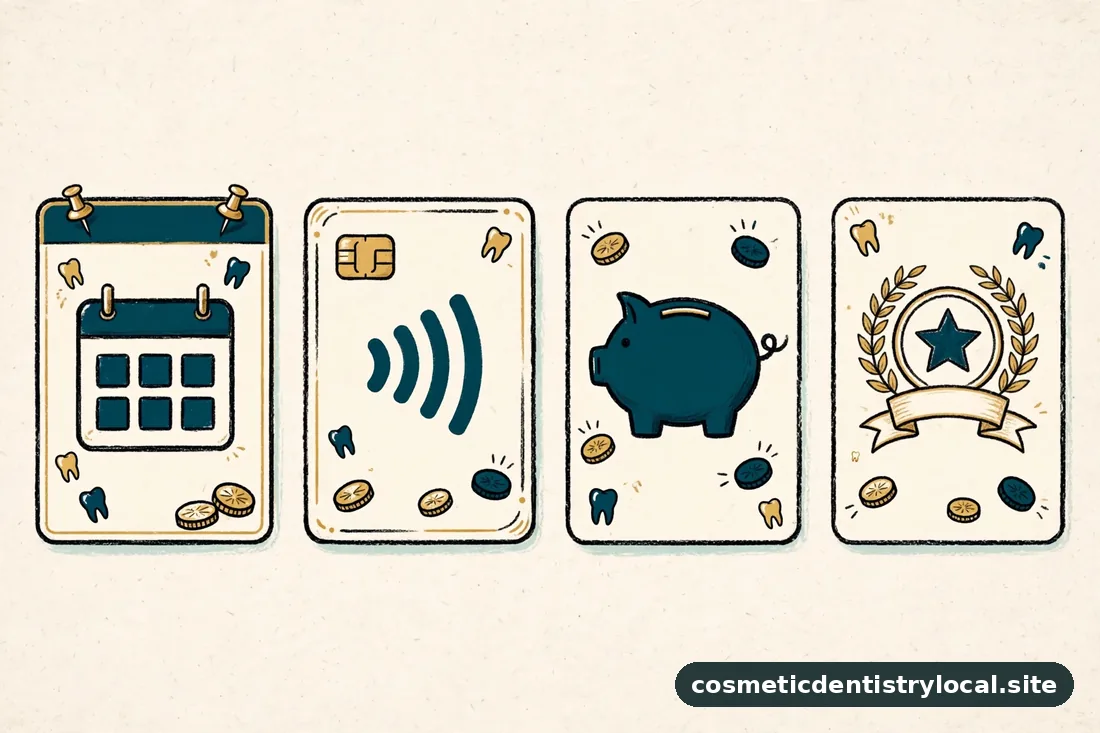
Most cosmetic dentistry is paid out of pocket — insurance almost never covers it — so how you pay matters as much as what you pay. The main options are in-office payment plans, medical credit cards, HSA/FSA pre-tax money, and dental savings plans. Each has different costs and traps. (58 words)
Key takeaways
- In-office payment plans are usually the cheapest financing — often 0% interest — but terms vary by practice, so get them in writing.
- HSA/FSA money pays for eligible dental work with pre-tax dollars; check current IRS limits and eligible-expense rules at IRS.gov.
- Medical credit cards can work with promotional 0% periods, but deferred-interest terms can retroactively charge interest on the full balance.
- Phased treatment (most visible teeth first) spreads a big plan across months or calendar years without any lender at all.
Start with the number, not the financing
Financing conversations go wrong when they start with the monthly payment. A $200/month plan sounds manageable until you learn it’s 48 months at 18% APR on a $7,000 veneer case. Always start from the total treatment cost, then work backward:
- Get the itemized written treatment plan with the all-in total.
- Check our cosmetic dentistry cost guide to sanity-check the quote against 2026 market ranges.
- Decide how much you can pay upfront — even a partial down payment shrinks whatever you finance.
- Then compare financing options by total cost, not monthly payment.
This order matters because financing can easily add 10–30% to the price of treatment. The cheapest financing is the kind you barely need.
In-office payment plans
Many dental practices offer their own payment plans, and these are often the best deal available: the practice splits your bill into monthly installments, frequently with no interest or a small administrative fee. There’s no third-party lender, no hard credit pull in most cases, and the terms are negotiable.
What to ask before signing:
- Is there interest, and if so, what rate and is it fixed?
- What happens if a payment is late — fees, or treatment paused?
- Is the plan contingent on completing all scheduled treatment?
- Can the plan be combined with an upfront-cash discount? (Many offices offer 5–10% off for payment in full — ask even if it isn’t advertised.)
The limitation is availability: not every practice offers plans, and smaller offices may only offer them for larger cases. If your dentist doesn’t offer one, the next options below fill the gap. For context on typical treatment totals, our porcelain veneers cost page shows per-tooth and full-smile numbers.
Medical credit cards
Medical credit cards (CareCredit is the best-known) are revolving credit lines designed for healthcare expenses, and many dental offices accept them. They typically offer promotional periods — often 6, 12, or 18 months — with no interest if the balance is paid in full within the window.
The trap is the phrase deferred interest. On many promotional plans, if you don’t pay the entire balance by the end of the promotional period, interest is charged retroactively on the original amount from day one — at rates that can exceed 25% APR. This is different from a true 0% APR offer and it catches people constantly.
Rules for using one safely:
- Only finance an amount you can realistically clear before the promotional period ends — set up autopay and calendar reminders.
- Read the terms to confirm whether it’s deferred interest or waived interest; they are not the same thing.
- Never use a medical credit card as an excuse to accept a bigger treatment plan than you budgeted for.
Used carefully, a promotional period is effectively a free short-term loan. Used carelessly, it’s one of the most expensive ways to pay for teeth.
HSA and FSA: the pre-tax discount
Health Savings Accounts and Flexible Spending Accounts let you pay for eligible dental expenses with pre-tax dollars — which is functionally a discount equal to your marginal tax rate. If you’re in a 22% federal bracket, $5,000 of veneers paid from an HSA costs you about $3,900 in real terms (Source: https://www.dentalplans.com/blog/what-dental-insurance-doesnt-cover/ — HSAs/FSAs noted as a way to “significantly reduce the effective cost of out-of-pocket treatments,” page opened and verified 2026-09-29).
Key differences:
- HSA (needs a high-deductible health plan): contributions are pre-tax, the money rolls over year to year, and it stays yours if you change jobs. The most flexible option if you have access.
- FSA (employer-provided): also pre-tax, but usually use-it-or-lose-it within the plan year (some plans allow a small rollover or grace period). If you’re planning veneers for next spring, contributing to next year’s FSA during open enrollment is smart timing.
- Eligible expenses generally include dental work that treats or prevents disease — and cosmetic dentistry sits in a gray area. Whitening done purely for appearance is typically not FSA/HSA-eligible; veneers or crowns that restore damaged teeth usually are. When in doubt, check the IRS eligible-expense guidance or ask your plan administrator before you pay.
Practical move: if you have an FSA, schedule treatment early in the year so the full annual contribution is available, or use the FSA debit card directly at the dental office.
Dental savings plans
Dental savings plans are not insurance — they’re membership programs that give you discounted rates at participating dentists. DentalPlans.com reports members save an average of 50% on many procedures, with plans starting around $7/month billed annually, and — critically for cosmetic patients — no deductibles, no waiting periods, and no annual limits (Source: https://www.dentalplans.com/blog/what-dental-insurance-doesnt-cover/, opened and verified 2026-09-29).
For cosmetic dentistry specifically, the value proposition is simple: insurance excludes the work, but a savings plan’s discounted fee schedule still applies to it. A $1,500 veneer at a 30–50% plan discount is $750–$1,050 — the membership pays for itself on a single tooth.
Caveats: you must use a participating dentist, the discount schedule varies by plan and region, and the “average savings” figure is an average — your actual discount depends on the procedure. Still, for anyone facing a multi-thousand-dollar cosmetic plan with no insurance help, this is one of the first things to check. See also our guide on whether dental insurance covers cosmetic dentistry for why the insurance route usually dead-ends.

Phased treatment: the overlooked strategy
The strategy nobody advertises, because no lender profits from it: split the treatment plan across time.
- Most visible teeth first. For a 6–8 veneer smile makeover, doing the front four now and the rest in six months halves the immediate bill — and lets you evaluate the result before committing to the rest.
- Across calendar years. If any portion of the work is covered (a crown after a root canal, for instance), scheduling covered work in one benefit year and cosmetic work in the next maximizes what insurance pays toward.
- Across FSA years. Contribute to an FSA two years running and you can fund a large plan with two years of pre-tax money.
- Whiten first, veneer second. Whitening ($400–$1,000 in-office) before veneers can reduce the number of veneers needed — veneers are shade-matched to surrounding teeth, so brighter natural teeth may mean fewer units.
Phased treatment requires a dentist willing to plan in stages and document the sequence. Ask for the phased plan in writing with per-phase pricing.
Traps and fine print
- Deferred interest (above): the single most expensive trap in dental financing. Confirm the exact terms in writing.
- “No credit check” lenders: some exist and can be legitimate, but the tradeoff is usually higher rates or fees. Compare total cost, not the approval pitch.
- Treatment upselling via financing: when the monthly payment looks small, it’s easy to agree to more treatment than you need. Decide the treatment plan first, on clinical grounds, then finance it.
- Dental tourism financing: some companies bundle overseas treatment with travel loans. The price looks dramatic until you add revision costs, travel, and the lack of local follow-up. Our budget smile guide covers tourism risks honestly.
- Balance transfers and new cards: opening a new 0% APR general credit card for dental work can work, but only with the same discipline as a medical card — and a hard inquiry dings your credit.
FAQ
Can I use HSA money for veneers?
It depends on why you’re getting them. HSA/FSA funds are meant for expenses that treat or prevent disease. Veneers or crowns placed to restore damaged teeth generally qualify; whitening or veneers done purely to change the appearance of healthy teeth typically don’t. Check IRS eligible-expense rules or ask your plan administrator before paying — and keep the itemized receipt.
What’s the cheapest way to finance a smile makeover?
Usually a combination: an in-office 0% payment plan for the portion you can’t pay upfront, HSA/FSA pre-tax dollars for the eligible portion, and a dental savings plan discount applied to the treatment total. Phasing the work across months multiplies the effect. Avoid deferred-interest credit products unless you’re certain you can clear the balance inside the promotional window.
Do dentists offer payment plans without a credit check?
Many in-office plans don’t involve a hard credit inquiry — the practice is extending you credit directly, often based on the treatment relationship rather than a score. Terms vary widely by practice, so ask explicitly: “Do you run a credit check for your payment plan?” Third-party financing (medical credit cards, personal loans) almost always involves a credit check.
Should I put cosmetic dentistry on a regular credit card?
Only if you can pay it off within a month or two, or you’ve secured a genuine 0% introductory APR with a clear payoff plan. Standard credit card APRs (often 20%+) make this one of the priciest ways to pay for treatment. A rewards card paid in full monthly is fine; carrying the balance is not.
The Smile Ledger is a price-research publication. This is general information, not medical or dental advice — talk to your dentist about your situation.