Whitening Strips vs Dentist Whitening: Honest 2026 Comparison
Whitening strips cost $20–$60 per course and lighten extrinsic stains by 1–3 shades; dentist in-office whitening costs $400–$1,000 per session and delivers 3–8 shades in one visit. Strips win on price and are the best-studied at-home option; the dentist wins on speed, concentration, and supervision. What decides it is your stain type, your deadline, and how sensitive your teeth run.
The short answer
Start with the cheap option and escalate only if needed. If your staining is mild surface yellowing from coffee and tea, a $20–$60 course of reputable strips is often all you need — it’s the best-studied at-home option with real results. If you have deep staining, an event in two weeks, or strips have already disappointed you, the dentist’s $400–$1,000 session buys speed and strength you can’t get from a box.
One rule overrides everything: whitening only works on natural enamel. Crowns, veneers, bonding, and fillings don’t change color — whitening around visible dental work can leave a mismatch that costs far more to fix than the whitening itself. A quick exam before you spend anything is the cheapest step in this whole process.
What strips actually do
Whitening strips are thin plastic films coated with hydrogen peroxide (typically 6–14% in reputable brands), worn about 30 minutes daily for one to three weeks. Published 2026 price data puts a course at $20–$60 (CreamyTales 2026 whitening data); another 2026 guide cites $20–$100 per pack (Vosita).
What they deliver: 1–3 shades of lightening on extrinsic (surface) stains, results visible in 1–3 weeks, lasting roughly 4–12 months. That’s a modest but real change — and strips are the best-studied over-the-counter format, with decades of use behind them. At roughly $2–$10 per treatment, they’re also the cheapest way to learn whether your stains even respond to peroxide. If strips do nothing after a full course, you may have intrinsic stains that need a dentist’s assessment, not a stronger box.
The honest limitations: strips don’t fit every tooth perfectly (less consistent coverage), they can irritate gums where gel pools, and they won’t touch deep or intrinsic discoloration. See our full professional whitening cost breakdown for how strips compare to every other option in one table.
What the dentist actually does
Dentist-delivered whitening comes in two forms:
In-office whitening uses high-concentration hydrogen peroxide — typically 25–40% — applied with gums carefully protected, sometimes with a light or laser. A single 60–90 minute session costs $400–$1,000 in 2026, with light-activated systems at the upper end, roughly $500–$1,500 in expensive markets (CreamyTales). Average nationwide cost sits around $650 (AZ Dentist). Most people see teeth several shades lighter in one visit — typically 3–8 shades — though deep cases can need two or three sessions.
Custom take-home trays are molded to your teeth by the dentist and filled with professional-strength gel worn daily for two to four weeks: $200–$500 for trays plus initial gel, with refill syringes around $30–$60. This is quietly the best value in professional whitening — the trays last for years and touch-ups cost almost nothing.
What the money buys beyond gel: a clinical exam first (whitening over a cavity can cause extreme pain), gum protection with resin barriers, and supervision if sensitivity spikes. Our dentist-vs-home comparison goes deeper on when professional supervision actually matters.
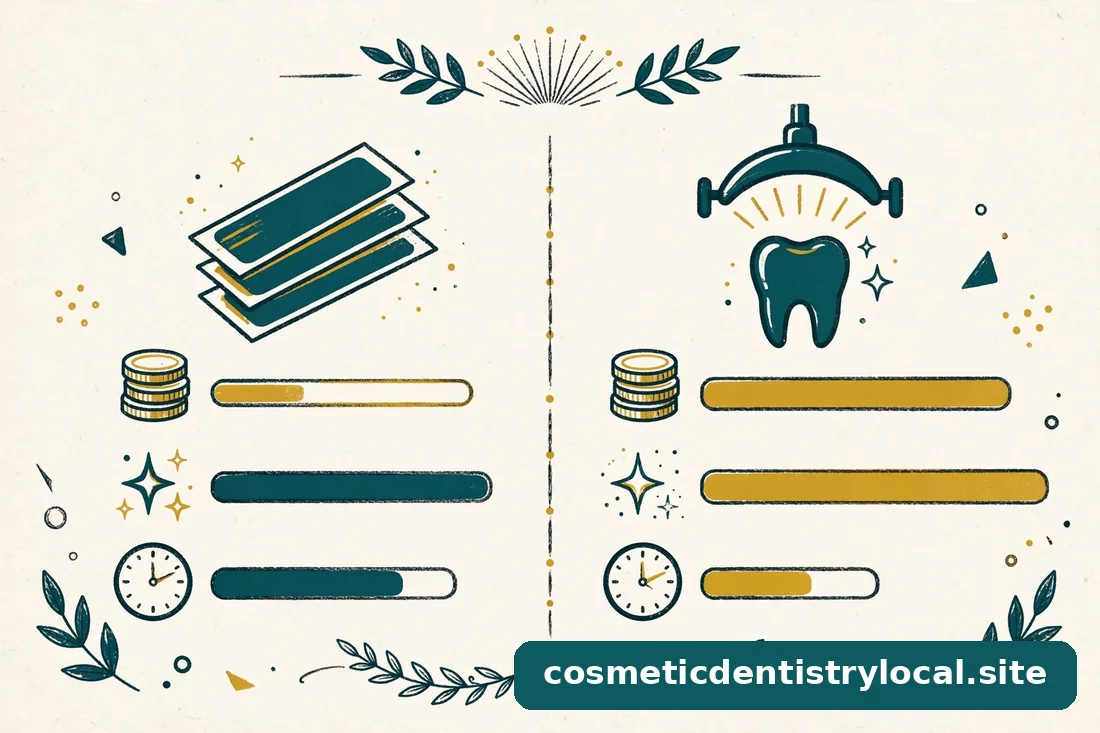
Side-by-side: cost, results, time
| Whitening strips | In-office dentist whitening | |
|---|---|---|
| 2026 cost | $20–$60 per course | $400–$1,000 per session |
| Typical result | 1–3 shades | 3–8 shades |
| Time to results | 1–3 weeks | 1 visit |
| Results last | 4–12 months | 1–3 years with care |
| Sensitivity risk | low–moderate | moderate (stronger gel) |
| Best for | mild surface stains | deep stains, deadlines |
The middle ground deserves its own row: dentist custom trays ($200–$500) deliver near-office results (3–6 shades) over 2–4 weeks, last 1–3 years, and refill cheaply. If you want the biggest change per dollar and can wait a few weeks, trays are the option dentists themselves often recommend over their own chairside service for budget-conscious patients.
The cost-per-shade math
Comparing sticker prices misses the point; compare what each dollar buys in visible change and how long it lasts.
- Strips: $40 for ~2 shades lasting 8 months ≈ $5/month of visible whitening. If you re-run a course yearly, ~$60/year.
- In-office: $650 for ~5 shades lasting 2 years ≈ $27/month amortized — but dramatically more visible change, in one afternoon.
- Custom trays: $400 setup + $40/year in refills, spread over 3 years ≈ $13/month — the sweet spot most people should know about.
None of these numbers include the hidden cost of the wrong choice: whitening when you have crowns on your front teeth, or whitening over untreated decay. Both turn a $40 experiment into a multi-thousand-dollar repair. That said — and this is the honest part — for mild yellowing on healthy natural teeth, strips are almost impossible to beat on value. They only “fail” when they’re asked to do a job they were never designed for.
Safety and sensitivity
Peroxide whitening has decades of safety data when used as directed. Temporary tooth sensitivity affects roughly half of users — usually peaking during treatment and fading within days of stopping. Gum irritation happens when gel sits on soft tissue, which is why tray fit matters so much. Using a sensitivity toothpaste with potassium nitrate for two weeks before whitening measurably reduces discomfort (CreamyTales).
Hold off on whitening — strips or dentist — if any of these apply:
- Untreated cavities, cracked teeth, or gum disease (peroxide reaching the inner tooth can cause real pain — treat first, whiten after).
- Pregnancy or breastfeeding: safety data is limited, and guidelines suggest waiting.
- A single dark tooth, which can signal a dead nerve needing dental attention, not bleach.
- Visible crowns or veneers that whitening would mismatch.
One more warning that applies to both sides: overuse is the real hazard. Whitening more often than directed doesn’t make teeth whiter; it makes them sensitive and chalky, and can damage enamel over time. White has a ceiling, and chasing an unnatural shade past it always backfires. Our complete cost guide covers when whitening is the right first step in a bigger smile plan.
The supporting cast: toothpaste, pens, and LED kits
Strips and the dentist aren’t the whole shelf. The other formats matter mostly as maintenance tools, and their honest role is worth knowing so you don’t overpay for them:
- Whitening toothpastes ($5–$15): remove surface stains with mild abrasives and help maintain results, but they can’t bleach the tooth itself. Best used daily after a real whitening round, not instead of one.
- Whitening pens ($10–$30): convenient for touch-ups after coffee-heavy weeks, but too little contact time for dramatic change.
- LED kits ($50–$200): the gel does the work; independent research finds the blue light adds little beyond marketing sparkle. Judge these kits by their gel concentration and fit, not the glow.
- Boil-and-bite tray kits ($20–$80): cheaper than dentist custom trays but leakier — more gel on gums, more irritation.
A realistic at-home budget for a noticeable result is $30–$100. Beyond that, you’re usually paying for packaging. None of these replace the core decision between strips and professional whitening; they orbit it.
The hybrid strategy most people should use
For the majority of adults with healthy teeth and moderate staining, the money-smart sequence is:
- Get a cleaning first ($75–$200). Polished teeth often look noticeably brighter, and your dentist can identify which stains are even bleachable.
- Try a reputable strip course ($20–$60) for mild yellowing. Give it the full 2–3 weeks before judging.
- Step up to custom trays ($200–$500) if you want a bigger change — this is the long-term value play.
- Reserve in-office sessions ($400–$1,000) for deep stains, intrinsic discoloration that needs professional-strength work, or a genuine deadline like a wedding.
Skip the upsells along the way: charcoal powders can be abrasive enough to wear enamel, purple color-correcting serums only mask yellow tones optically for hours, and the blue LED light in at-home kits adds far less than its price suggests — independent research finds the gel does the work.
Key takeaways
- Strips ($20–$60): 1–3 shades, best-studied OTC option, ideal for mild surface stains.
- In-office ($400–$1,000): 3–8 shades in one visit, best for deep stains and deadlines.
- Custom take-home trays ($200–$500) are the best value per dollar — near-office results, cheap touch-ups for years.
- Whitening only works on natural enamel; get a checkup before spending money, and never overuse.
FAQ
Do whitening strips damage enamel?
Used as directed, reputable strips don’t permanently damage enamel — peroxide temporarily opens enamel’s microscopic structure to reach stains, and decades of clinical research support that. Damage comes from overuse, abrasive add-ons like charcoal, and whitening over untreated decay. If you have significant sensitivity or dental work, do your first round under a dentist’s guidance.
Can strips work as well as the dentist?
Given enough weeks, quality strips can reach results close to a single in-office session for mild extrinsic stains. What they can’t match is speed, supervision, and the highest gel concentrations. Deep or intrinsic staining generally needs professional treatment — or may not bleach at all.
Why didn’t strips work for me?
Three common reasons: your stains are intrinsic (inside the tooth, from aging, medication, or trauma); you have whitening-resistant dental work on visible teeth; or you stopped after a week instead of completing the course. A dentist can assess stain type in one exam — and it’s worth it before spending on stronger products.
How often can I whiten my teeth?
For most people, a full whitening treatment once a year with occasional touch-ups is perfectly safe. Over-whitening can lead to a translucent, bluish-grey appearance that looks unnatural and can cause chronic sensitivity. When in doubt, fewer treatments, not more.
Sources: opened and verified — CreamyTales 2026 whitening data (strips $20–$60, in-office $400–$1,000, laser $500–$1,500, trays $200–$500, shade ranges, safety data); Vosita 2026 guide (strips $20–$100, in-office $400–$1,200, Zoom $500–$1,200); AZ Dentist (national average ~$650, take-home kits $100–$400).
This is general information, not medical or dental advice — talk to your dentist about your situation.