Dental Crown Cost for Front Teeth in 2026 (Cosmetic Guide)
A dental crown on a front tooth costs $800 to $3,000 in the US in 2026, depending on the material. CareCredit’s procedure costs list averages of $1,399 for porcelain and $1,114 for PFM — though front teeth almost always get ceramic options. This guide covers crowns through the cosmetic lens: cost, materials, and when they beat veneers.
Front-Tooth Crown Prices by Material
| Material | Typical range | National average | Best for |
|---|---|---|---|
| Porcelain / ceramic (e.g., e.max) | $800–$1,800 | $1,399 | Front teeth — best aesthetics |
| Zirconia | $1,000–$2,500 | ~$1,500 | Front teeth needing extra strength |
| Porcelain-fused-to-metal (PFM) | $600–$1,400 | $1,114 | Budget option; metal line risk at gum |
| Gold / metallic | $800–$1,500 | $1,211 | Rarely used on front teeth |
| Resin / temporary | $300–$700 | $697 | Short-term only, not a final restoration |
Front-tooth work is dominated by all-ceramic options — porcelain and zirconia — because they mimic natural enamel’s translucency. PFM crowns are cheaper but can show a dark line at the gumline as gums recede, which is why cosmetic dentists rarely recommend them for visible teeth despite the lower price.
Premium labs and high-end ceramics (like lithium disilicate, marketed as e.max) sit at the top of the porcelain range. The material genuinely affects the result: better ceramics layer translucency more like real enamel. For a single front tooth next to natural teeth, the premium may be worth it — a flat-looking crown on a central incisor is conspicuous in a way a molar crown never is.
Key takeaways
- Front-tooth crowns cost $800–$3,000; porcelain averages $1,399 nationally (CareCredit).
- All-ceramic (porcelain, zirconia) is the standard for visible teeth; PFM risks a visible metal line.
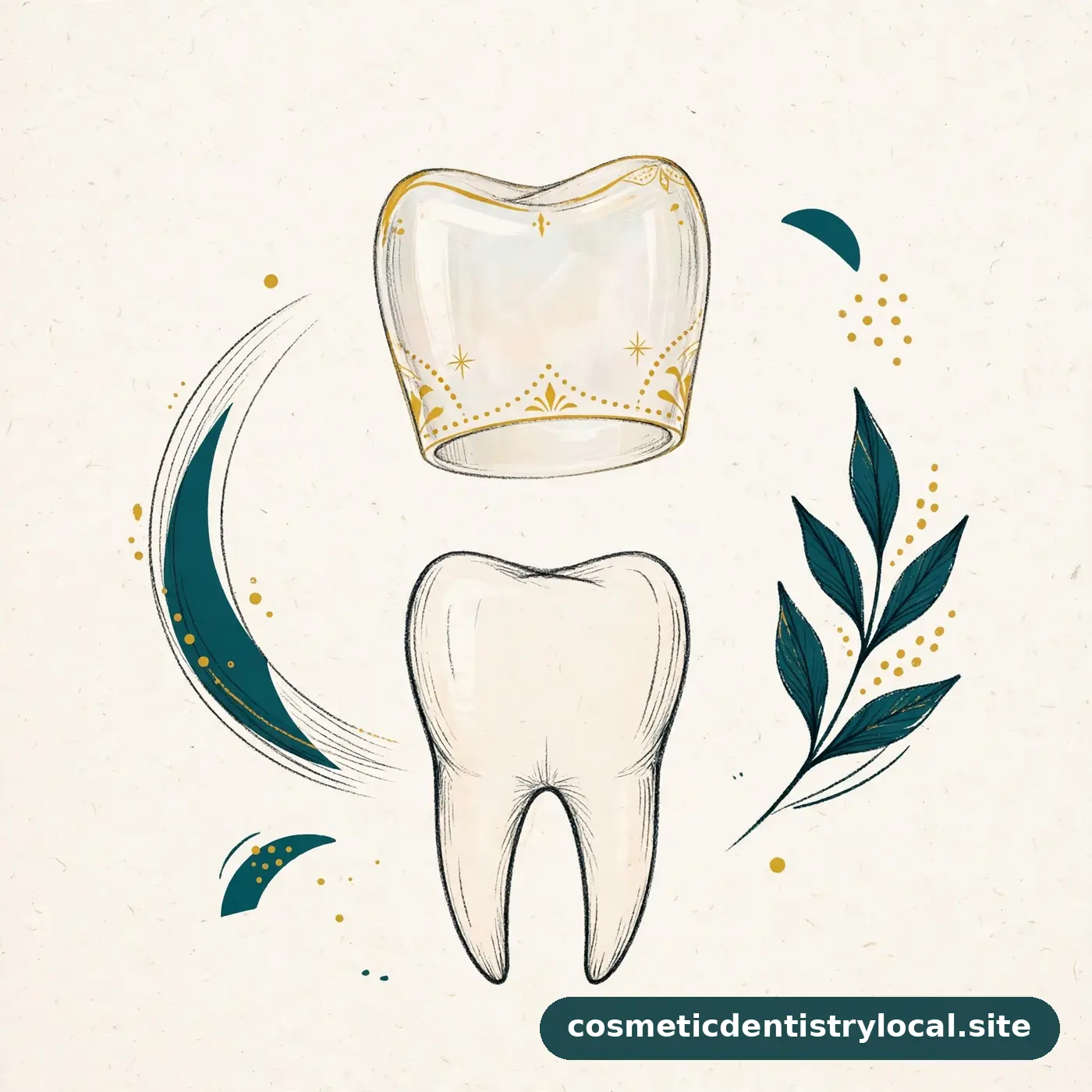
- Crowns cover the whole tooth — necessary when a veneer’s thin shell isn’t structurally enough.
- Unlike veneers, crowns for damaged teeth may get partial insurance coverage.
When a Crown Beats a Veneer
Veneers get more attention, but crowns are the right answer in several common situations:
The tooth is structurally compromised. A veneer is a thin shell bonded to the front surface — it needs a healthy tooth underneath. Teeth with large fillings, root canals, cracks, or significant decay need a crown’s full coverage. Putting a veneer on a weak tooth is building on a bad foundation.
After a root canal. Front teeth that have had root canals become brittle over time. A crown protects against fracture — this is standard-of-care advice, not upselling.
Severe discoloration. Tetracycline staining or darkening after trauma can be too deep for a thin veneer to mask. A crown’s opacity covers what a veneer can’t.
Bite and shape changes. When a tooth needs significant reshaping — shortening, major recontouring — a crown gives the dentist more material to work with than a 0.5mm veneer shell.
The cost comparison: porcelain veneers average $1,455 per tooth vs. $1,399 for a porcelain crown — essentially the same price. The choice should be clinical, not financial. If a dentist recommends a crown where you expected a veneer (or vice versa), ask them to explain the structural reasoning. “The tooth needs full coverage because…” is the sentence you want to hear.
The Cosmetic Considerations
A front-tooth crown lives in the most visible real estate in your mouth. Getting it right involves details that don’t matter for back teeth:
Shade matching. A single crown must blend with adjacent natural teeth — the hardest shade match in dentistry. This is where premium labs earn their fee. Ask whether the dentist uses a custom shade (photos sent to the lab) versus a stock shade tab; custom shading costs more and looks better.
Translucency. Natural teeth transmit light. Cheap opaque crowns look flat and “chicklet-like.” Lithium disilicate and layered zirconia mimic translucency best.
Gumline aesthetics. The crown’s edge meets the gum — the most scrutinized millimeter in cosmetic dentistry. All-ceramic crowns avoid the dark line that PFM crowns can develop. If your gums are thin or you have a high smile line (lots of gum showing), this matters more.
Symmetry. Front teeth come in pairs. If you’re crowning one central incisor, the dentist should evaluate whether the other needs at least minor cosmetic work for symmetry. Sometimes the answer is a matching veneer on the neighboring tooth.
Temporaries matter. You’ll wear a temporary crown for 1–3 weeks while the lab works. On a front tooth, ask for a well-made temporary — you’ll be smiling with it in public.
The Procedure and Timeline
A crown takes two appointments, typically 2–3 weeks apart:
- Preparation visit (60–90 min). The tooth is shaped, impressions or digital scans are taken, shade is selected, and a temporary crown is placed. Local anesthesia is standard.
- Lab phase (1–3 weeks). The ceramist fabricates your crown. Same-day CEREC crowns skip this — milled in-office in about two hours — but the aesthetics may not match a master ceramist’s hand-layered work for front teeth.
- Placement visit (30–60 min). The temporary comes off, the permanent crown is tried in, adjusted for bite and shade, then cemented.
Sensitivity to hot and cold for a few days after placement is common and usually resolves. Persistent pain, or a bite that feels “high,” warrants a call to the office — bite adjustments are quick and routine.
As with veneers, whiten first if you’re considering it. The crown’s shade is permanent; whiten your natural teeth beforehand and match the crown to the result.
Insurance: The Crown’s Quiet Advantage
Here’s where crowns differ meaningfully from veneers: crowns are often partially covered by insurance when they’re medically necessary. A crown on a cracked tooth, a tooth with a large failing filling, or a tooth after root canal treatment is restorative dentistry — most PPO plans cover 50% of the contracted rate after deductible.
The cosmetic upgrade within a covered crown is usually yours to pay: if insurance covers a basic PFM crown but you want premium all-ceramic, you may owe the difference. Ask the office to submit a pre-treatment estimate showing exactly what the plan covers and what you’ll owe — this is standard practice and takes the guesswork out.
Purely cosmetic crowns — placed on healthy teeth solely for appearance — are treated like veneers: excluded. The coverage attaches to the diagnosis, not the procedure name. Documentation (X-rays showing decay, fracture, or large restoration) is what makes the difference.
If a crown is part of a bigger aesthetic plan, our smile makeover cost guide shows how crowns combine with veneers and whitening in coordinated treatment plans — and our complete cost guide covers the full price landscape.
Same-Day (CEREC) Crowns vs. Lab Crowns
You’ll often be offered a choice between a same-day milled crown and a traditional lab-made crown. The tradeoff is real:
| Same-day (CEREC-type) | Lab-made | |
|---|---|---|
| Appointments | 1 (about 2 hours) | 2, spaced 1–3 weeks |
| Temporaries | None needed | Worn 1–3 weeks |
| Aesthetics | Good; single-block ceramic | Excellent; hand-layered by ceramist |
| Shade customization | Limited | Full custom shading |
| Typical cost | Similar or slightly less | $100–$400 more |
For back teeth, same-day crowns are a genuine convenience win. For front teeth, the aesthetic gap matters: a master ceramist layering porcelain by hand can match translucency and characterization that a milled block can’t fully replicate. If you’re crowning a highly visible central incisor, the lab route is usually worth the wait and the modest premium. For a less visible lateral incisor or canine, same-day is a reasonable choice.
Either way, the fundamentals don’t change: the preparation, the fit, and the bite adjustment determine most of the outcome. A well-made same-day crown beats a poorly made lab crown every time — so the dentist’s skill matters more than the manufacturing method.
FAQ
How much does a crown cost for a front tooth?
$800 to $3,000 depending on material. National averages (CareCredit): porcelain $1,399, porcelain-fused-to-metal $1,114, metallic $1,211. All-ceramic options (porcelain, zirconia) are standard for front teeth and sit in the $800–$2,500 range.
Is a crown better than a veneer for front teeth?
It depends on the tooth’s condition. Veneers are less invasive and ideal for healthy teeth needing cosmetic improvement. Crowns are necessary when the tooth is weakened by large fillings, cracks, root canals, or severe discoloration. The prices are similar (~$1,400–$1,455 average), so let the clinical need — not the price tag — decide.
How long do front-tooth crowns last?
Typically 10–15 years, with many lasting 20+. Longevity depends on oral hygiene (decay can still form at the crown’s edge), teeth grinding (a night guard helps significantly), and the quality of the initial fit. Porcelain can chip — avoid chewing ice and hard candies on crowned teeth.
Does insurance cover crowns on front teeth?
Often partially — when the crown is medically necessary (decay, fracture, post-root-canal protection), most dental plans cover around 50% after deductible. Purely cosmetic crowns on healthy teeth are excluded. Get a written pre-treatment estimate from your insurer before scheduling.
Can a front crown be whitened later?
No. Like all dental restorations, crowns don’t respond to whitening gel. If you whiten your natural teeth after getting a crown, the crown will look darker by comparison. Always complete any whitening before the final shade is selected for the crown.
What’s the difference between a porcelain crown and a zirconia crown?
Both are tooth-colored and metal-free. Porcelain (especially lithium disilicate) offers the most natural translucency — ideal for front teeth. Zirconia is stronger and slightly less translucent — better when the tooth takes heavy bite force or needs maximum durability. For most front teeth, either works; your dentist can recommend based on your bite.
This is general information, not medical or dental advice — talk to your dentist about your situation.