Veneers vs Bonding: Which Is Worth the Money in 2026?
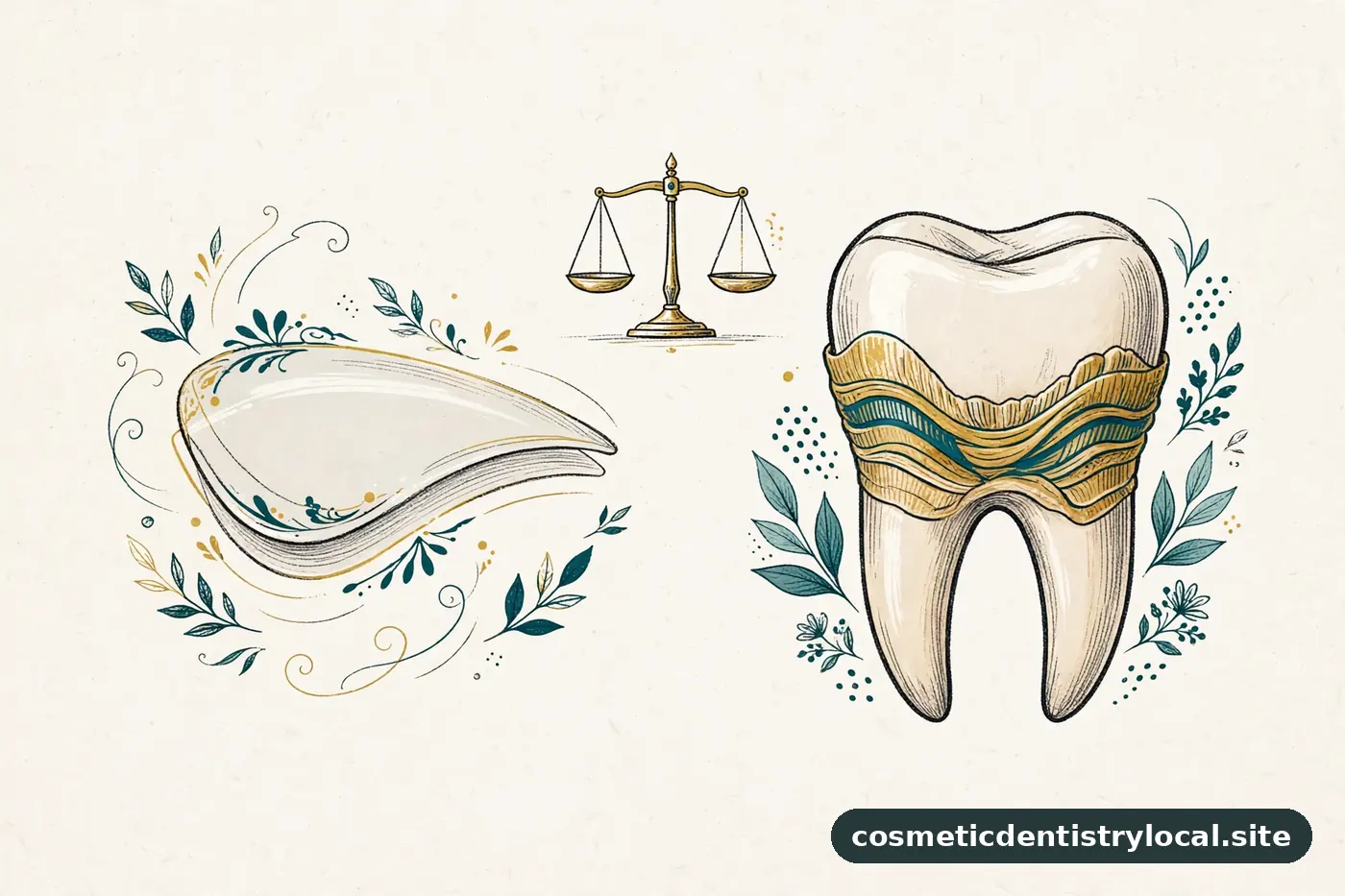
Porcelain veneers ($925–$2,500 per tooth, lasting 10–20 years) are the premium long-term fix; composite bonding ($100–$600 per tooth, lasting 3–10 years) is the affordable same-day fix for smaller flaws. Veneers win on durability and stain resistance; bonding wins on price and reversibility. The deciding factor is lifetime cost per year. (58 words)
Key takeaways
- Porcelain veneers: $925–$2,500/tooth, 10–20 year lifespan, best stain resistance, two visits.
- Composite bonding: $100–$600/tooth, 3–10 year lifespan, single visit, easier and cheaper to repair.
- Over 20 years, one porcelain veneer ($~1,400) can cost less than bonding replaced three times.
- Bonding is the right call for small chips and gaps; veneers for full smile transformations and heavy staining.
The 60-second comparison
| Porcelain veneers | Composite bonding | |
|---|---|---|
| Cost per tooth (2026) | $925–$2,500 | $100–$600 |
| Typical lifespan | 10–20 years | 3–10 years |
| Visits | 2–3 | 1 (same day) |
| Enamel removed | Small amount (usually) | Little to none |
| Stain resistance | Excellent | Fair — stains over time |
| Repair | Replace the veneer | Easy chairside touch-up |
| Best for | Full smile makeovers, discoloration, shape changes | Chips, small gaps, minor shape fixes |
Price ranges reflect published 2026 US market data (Source: https://acibademinternational.com/blog/porcelain-veneers-cost-what-shapes-the-price-of-a-lasting-smile/ — US typical porcelain $900–$2,500, bonding $100–$500, verified via search 2026-09-29).
What each one actually is
Porcelain veneers are thin ceramic shells, custom-made in a dental lab from a scan or impression of your teeth, then bonded to the front surface. A small amount of enamel is usually removed so the veneer sits flush. The process takes two to three visits: preparation and impressions, a temporary veneer phase, then bonding of the final shells.
Composite bonding uses a tooth-colored resin applied directly to the tooth, sculpted by hand, and hardened with a curing light — all in one visit. Little or no enamel is removed. It’s the same material as a tooth-colored filling, used cosmetically.
The practical difference: veneers are manufactured (lab precision, ceramic material), bonding is sculpted (dentist artistry, resin material). Both depend heavily on who’s doing the work — a great bonding artist beats a mediocre veneer lab, and vice versa. Our porcelain veneers cost guide and dental bonding cost guide give the full per-tooth breakdowns.
Cost: per tooth and per smile
Veneer pricing is per tooth, so the totals multiply fast:
| Teeth treated | Porcelain veneers | Composite bonding |
|---|---|---|
| 1 tooth | $925–$2,500 | $100–$600 |
| 4 teeth | $3,700–$10,000 | $400–$2,400 |
| 6 teeth (typical smile zone) | $5,550–$15,000 | $600–$3,600 |
| 8 teeth | $7,400–$20,000 | $800–$4,800 |
These are before any prep work (cleanings, X-rays, gum contouring) that may be quoted separately. Note the overlap: eight bonded teeth at the top of the bonding range can cost more than four veneers at the bottom of the veneer range. Per-tooth thinking beats sticker-shock thinking — see the complete cost guide for how quotes are built.
The lifetime-cost math
This is the comparison almost nobody publishes, and it’s the one that matters most. Take a mid-range case — one tooth, porcelain veneer at $1,400 vs bonding at $350:
- Veneer: $1,400 once, lasts ~15 years → ~$93/year
- Bonding: $350, replaced every ~5 years → 3 replacements over 15 years = $1,050 → ~$70/year
At these midpoints, bonding is still cheaper per year — but the gap is much smaller than the sticker prices suggest ($1,400 vs $350 looks like 4x; per-year it’s about 1.3x). And the math flips in plausible scenarios:
- If bonding needs replacement every 3 years (heavy coffee drinker, teeth grinder): 5 replacements = $1,750 → $117/year — more than the veneer.
- If the veneer lasts 20 years: $1,400 / 20 = $70/year — dead even with bonding.
The honest conclusion: veneers are the better long-term value for front-and-center teeth you’ll keep for decades; bonding is the better value for minor fixes and for teeth where you’re unsure about committing. Neither is “cheaper” in the abstract — it depends on your habits and timeline. Our guide on how long veneers last digs into what extends or shortens that lifespan.
Appearance and durability, honestly
Stain resistance is the clearest material difference. Porcelain is glazed ceramic — coffee, tea, and red wine slide off it for years. Composite resin is porous by comparison and picks up stains gradually; a bonded front tooth can look noticeably duller than its neighbors after a few years. Polishing visits can refresh it, but the material has a ceiling.
Strength favors porcelain too: it’s harder and more chip-resistant than composite. But “harder” cuts both ways — when a porcelain veneer does fail, it usually needs full replacement ($925–$2,500 again). A chipped bonding repair is a 30-minute, few-hundred-dollar chairside fix.
Reversibility favors bonding decisively. Veneers require removing enamel — a permanent change. Bonding typically removes little to nothing, so you’re not locked in. For younger patients or anyone hesitant about permanent alteration, that matters.
Aesthetics at day one: a top-tier ceramist’s porcelain veneer is essentially indistinguishable from a natural tooth. Excellent bonding can look just as good on day one — the difference shows up at year three, not day one.
Maintenance: what each one asks of you
The purchase price is only the beginning of the relationship. Here’s what living with each option actually involves:
Bonding maintenance is the higher-effort of the two. Composite resin stains gradually, so most dentists recommend a professional polish every 6–12 months to keep bonded teeth matching their neighbors — often done during a regular cleaning visit at little or no extra charge. Between visits, the usual suspects (coffee, tea, red wine, tobacco) stain bonding faster than natural enamel, so heavy consumers of any of those should expect the shade gap to show sooner. Small chips are a fact of life with resin; the upside is that repairs are quick, cheap ($100–$300 for a touch-up), and don’t require redoing the whole tooth.
Veneer maintenance is closer to “treat them like natural teeth, plus a few rules.” Porcelain doesn’t stain, so there’s no polishing treadmill. The rules: wear a night guard if you grind (a $300–$600 custom guard protects a $1,400 veneer — the math is obvious), don’t use your teeth as tools, and keep up with regular cleanings since gum health determines how long the veneer margins stay invisible. If a veneer does chip or debond, it’s a lab remake — plan on the better part of the original per-tooth cost and another two visits.
One cost people forget for both options: replacement is priced at future rates, not today’s. A veneer placed at 30 and replaced at 45 will be replaced at 2041 prices. This doesn’t change the comparison between the two materials, but it’s worth remembering when anyone quotes you a “lifetime” figure.
Which one fits your situation
Bonding is probably the right call when:
- The flaw is small: a chip, a small gap, a slightly uneven edge
- You want the lowest upfront cost ($100–$600 per tooth)
- You’re under ~25 and your smile is still “settling” — bonding buys time before a permanent decision
- You want a reversible first step before committing to veneers
Veneers are probably the right call when:
- You’re treating 4+ visible teeth as a set (a smile zone transformation)
- Staining is intrinsic (tetracycline staining, fluorosis) that whitening can’t fix
- You want the longest-lasting, lowest-maintenance result
- The lifetime-cost math favors “do it once, do it well”
Consider neither (yet) when:
- You have untreated cavities, gum disease, or bite problems — cosmetic work on an unhealthy foundation fails early. Fix health first.
- You grind your teeth heavily and won’t wear a night guard — both options fail faster, and the replacement math gets ugly.
If budget is the binding constraint, our cheapest ways to fix your smile guide ranks every budget route honestly.
FAQ
Can bonding look as good as veneers?
On day one, excellent bonding can look essentially as good as veneers for small corrections — the artistry is in the dentist’s hands. The difference emerges over time: porcelain keeps its glaze and shade for a decade or more, while composite gradually stains and dulls. For a single chipped tooth, most people can’t tell the difference. For six front teeth, veneers hold their appearance far longer.
Does bonding damage your teeth?
Bonding is among the least invasive cosmetic procedures — it typically requires little to no enamel removal, and the resin bonds to the existing tooth surface. That’s what makes it reversible in a way veneers aren’t. The main “damage” risk isn’t the procedure; it’s neglecting the underlying tooth (bonding over an untreated cavity, for example).
How many times can bonding be replaced?
There’s no fixed limit — bonding can be removed and redone multiple times since so little tooth structure is involved. Each replacement is a straightforward single-visit procedure at $100–$600 per tooth. The practical limit is your patience with the maintenance cycle and the cumulative cost, which is where the lifetime math above comes in.
Is it weird to get bonding on some teeth and veneers on others?
Not at all — it’s common. A typical plan might put veneers on the most visible front teeth and use bonding for minor chips on teeth further back in the smile. A good cosmetic dentist plans the smile as a whole and mixes materials where each makes sense. Ask for the per-tooth plan in writing.
The Smile Ledger is a price-research publication. This is general information, not medical or dental advice — talk to your dentist about your situation.